A Field Report on Local Reviews

The Five-Star Lie
A field report on the quiet math of online reviews — and why your perfect rating is, almost certainly, costing you customers.
by andrew miller, co-founder of omada

13 min read

chapter I

observation
The Hairstylist's Forty-Seven Stars
I met a stylist last spring, three months into the soft launch of her second location. Forty-seven reviews in. Every single one of them five stars. She had been handing each customer her phone after the cut — still in the chair, still smelling of clippers and fresh shampoo — and walking them through the review process while the haircut was at peak satisfaction. It worked. She had, by any reasonable definition of the word, a perfect rating.
She showed me her profile, and asked the question every honest small-business owner eventually asks: "why isn't this working?"
Bookings, in three months, had not moved.
The truth, which I had to tell her gently because she had earned every one of those stars, is that her 5.0 rating was not helping her. It was, very quietly, almost certainly hurting her. There is a body of academic research on this, going back almost a decade, and the finding is consistent across millions of reviews and forty-plus product categories: customers do not trust 5.0 ratings. They trust 4.5. They trust 4.6. They trust the rating that admits a single bad day. The perfect rating triggers something old and protective in the human brain — a small voice that says, this is too clean, this is curated, this is not how the world actually works.

This is the first thing the marketing industry has, very politely, been telling small-business owners wrong about reviews. There are several others. This is a field report on all of them — on the actual academic research that explains why your customers behave the way they do, on the dollar value of a single star, on the reply you didn't realize was a billboard, and on the seven seconds of customer experience that decide whether a five-star review ever gets written at all.
It is, like everything else in local business, a story about behavior — not technology. The good news is that once you see the math, you cannot unsee it. The better news is that almost none of your competitors have.

chapter II
the curve
The Spiegel Curve, and the Math of Doubt
In 2017, three researchers at Northwestern University published a paper with a title written specifically to annoy retailers: "Too Good to be True." They had partnered with PowerReviews to analyze millions of consumer reviews across forty product categories. They were trying to answer a question every small-business owner has asked: does a higher star rating actually lead to more sales?
The answer they found was: yes — but only up to a point.
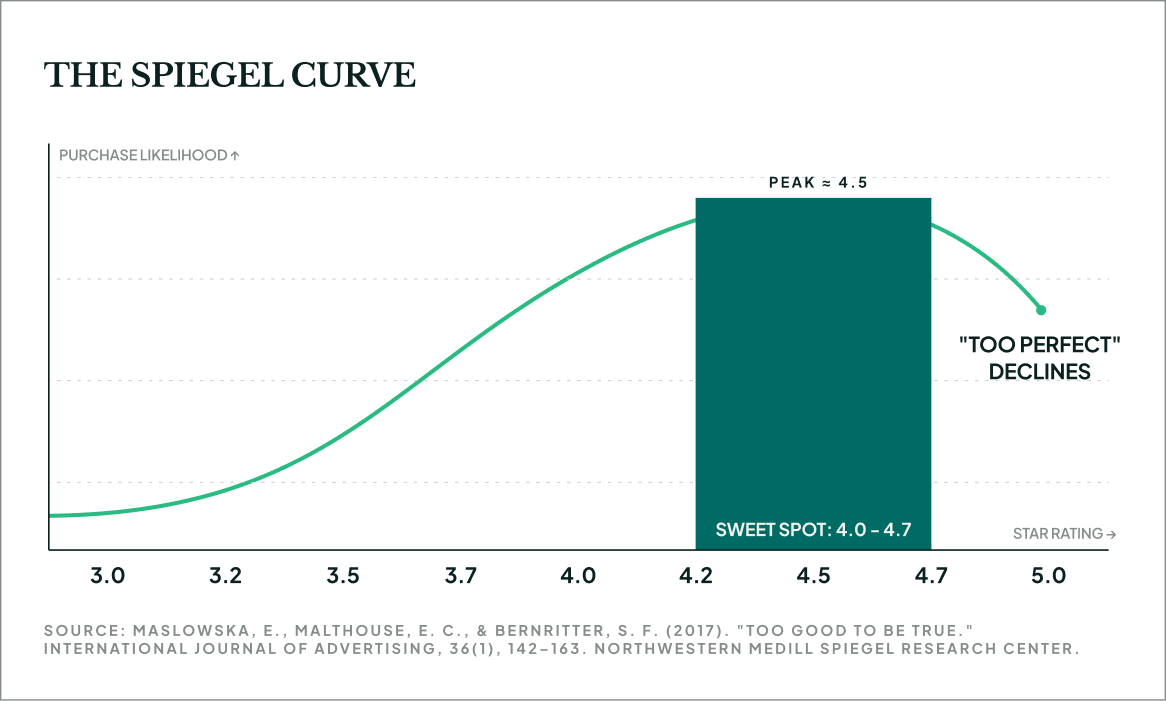
Across every category they studied, purchase likelihood climbed steadily as ratings improved from 3.0 to about 4.5. Then something strange happened. As ratings moved past 4.7, toward the perfect 5.0, purchase likelihood stopped climbing — and began to decline. In no category — not one — was the optimal rating a perfect 5.0. In nearly every category, the sweet spot sat somewhere between 4.0 and 4.7.
Below is the curve, drawn the way Spiegel found it.
Customers do not pick the best business. They pick the one that feels least likely to disappoint them.
The mechanism, when you stop and think about it, is intuitive. A 5.0 rating breaks the customer's mental model of the world. Real businesses, on real Tuesdays, occasionally have a bad day. A waiter forgets the salt. A barber takes off a quarter-inch too much. A contractor shows up forty minutes late because a job ran long. These small failures are, the customer's brain has come to believe, what reality looks like. A profile that has them, in modest quantity, reads as real. A profile that has none of them — somehow, every customer perfectly satisfied, every interaction a triumph — reads as curated.
Spiegel found that the trust signal isn't perfection. It's the ratio of believable signal to suspicious noise. Their words, in the actual paper: "shoppers see ratings at the far end of the spectrum as 'too good to be true.'" A few imperfect reviews don't undermine the pattern; they establish it. They are the proof that no one's hand has been on the scale.
There is a counter-intuitive correlate to this finding that small-business owners almost never act on, and it is this: do not delete your three-star reviews. Do not pressure customers to take down their lukewarm ones. The presence of a 3.4-star review next to forty-two 4.8s is not a stain on your record. It is the thing that makes the forty-two 4.8s legible.

chapter III
Volume
The Number That Beats The Number
There is a second, larger trick the marketing industry has been hiding from you in plain sight: the average rating is not the most important number on your profile. The number of reviews behind the average is.
BrightLocal's 2026 Local Consumer Review Survey — based on a representative panel of 1,002 US adults, conducted via SurveyMonkey — found that 55% of consumers prefer a business with many reviews and an average rating over one with a few reviews and an excellent rating. Nearly nine in ten consumers expect business owners to respond to reviews. Forty-one percent now say they "always" read reviews when picking a local business — a twelve-point jump from the year before.
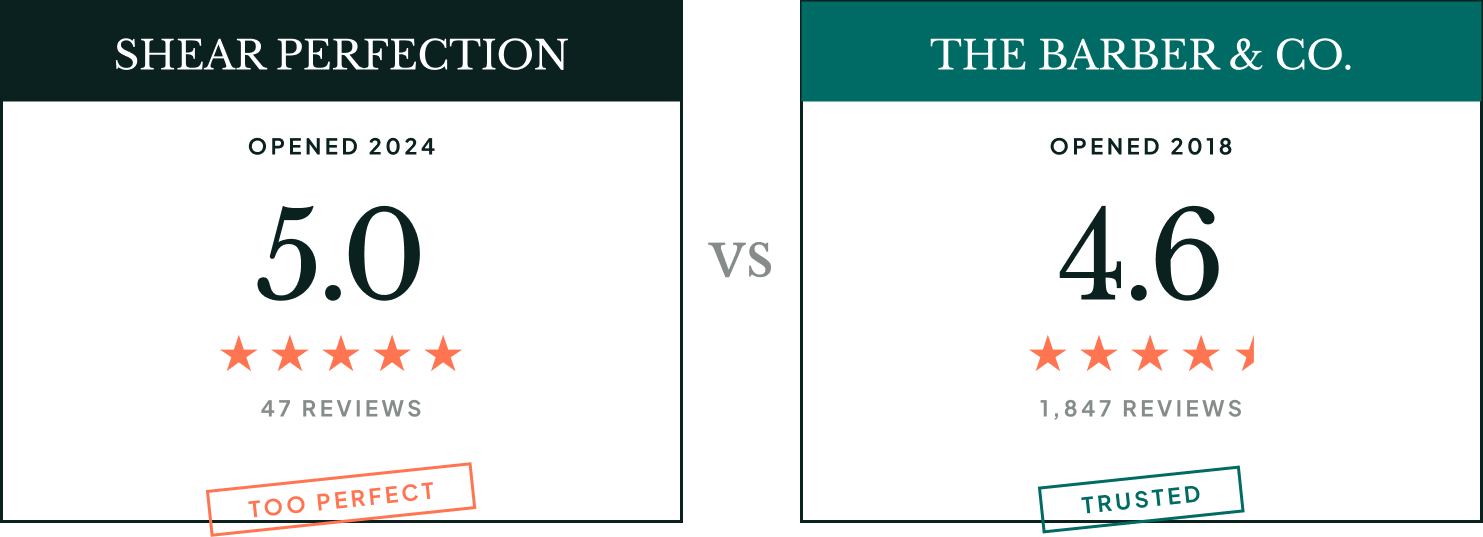
A choice, then. Pretend you have just searched for a hair salon in your neighborhood. The two most-clicked results are below. Click whichever one you would actually pick. Don't overthink it.
Shear Perfection
HAIR SAlON · 0.4 mi · OPENED 2024
5.0
★★★★★
(47 reviews)
All from the last 60 days
The Barber & Co.
HAIR SAlON · 0.3 mi · OPENED 2018
4.6
★★★★☆
(1,847 reviews)
owner replies to most
If you picked The Barber & Co., you're in the company of roughly four out of five people in informal user-research panels we've watched, and the company of most of the consumers BrightLocal has been surveying for fifteen years. The reasoning is not what you'd expect. It isn't that they think the rating is necessarily more accurate. It's that they think the set of reviews is more trustworthy. Forty-seven reviews, all five stars, all from the last sixty days, reads to the brain as a small population that may or may not represent reality. 1,847 reviews, averaging 4.6, with the owner replying to most of them, reads as a real business that has been quietly running for years.
There is a Northwestern finding here too, and it is striking. The Spiegel research found that nearly all of the conversion lift from reviews comes from the first ten reviews — and the first five alone drive the bulk of it. Beyond about ten reviews, the marginal value of an additional review is small. But that is the marginal value to a visitor's confidence. The marginal value to your visibility — to being shown to a stranger at all — keeps climbing for years.
Volume is a slow asset. It compounds. It is the single hardest-to-fake signal of legitimacy a small business can own.

chapter IV
the dollar
The Dollar Value of One Star
In 2011, an assistant professor at Harvard Business School named Michael Luca published one of the cleanest pieces of small-business research of the last twenty years. He combined every review on Yelp.com for restaurants in Seattle with hard restaurant-revenue data from the Washington State Department of Revenue. He had, in other words, ratings on one side of the ledger and actual money on the other.
Then he did something elegant. Yelp displays restaurant ratings rounded to the nearest half-star — a 3.24 rating shows as three stars, a 3.25 rating shows as three-and-a-half. Customers see the rounded number; they do not see the underlying decimal. So Luca compared restaurants whose underlying ratings sat just above and just below those rounding thresholds. The two restaurants are essentially identical in actual quality. The only difference is the half-star a customer sees on the page.
What he found has been replicated dozens of times since. A one-star increase on Yelp leads to a 5–9 percent increase in revenue. Not a 5–9 percent increase in customers. A 5–9 percent increase in revenue. Per star.
There are two further findings in the paper that should be quoted in every conversation a small-business owner ever has with a marketing agency. First: this effect is driven entirely by independent restaurants. Chain restaurants see no statistically significant impact — because customers already have a brand impression of a chain, and the reviews don't change it. Reviews are not just helpful for independents; they are especially helpful for independents. They are the lever by which the un-known business becomes the known one. Second, and more recently, the same effect has been observed across categories: dentists, gyms, hotels, contractors, mortgage brokers. Wherever a service is repeatable and local, a single star is worth real money.
Below is the math, rendered onto whatever scale of business you happen to operate. Move the slider.
The number you just generated is the conservative case. Luca's paper deliberately measured a single rounding threshold — a half-star or full-star bump. The compounding effect across multiple stars, multiple years, and an audience that doubles every quarter as Google's local pack picks you up more often, is harder to model and considerably larger. What is not hard to model is the alternative. A business that does not actively cultivate its review profile leaves that number — every year, in perpetuity — on the table. Not in lost margin. In foregone revenue.
This is the part the marketing industry, very politely, does not lead with. They will sell you a $700-a-month ad spend campaign that, if it works perfectly, generates a few hundred dollars of trackable bookings. The free thing — asking your customers, well, in the right moment, with the right script — generates the slider above. Per year. Forever.

chapter V
the REPLY
The Reply Is for the Next Reader
There is a small, almost free behavior that separates the top decile of local businesses from everyone else, and it is this: they reply to their reviews. Not all of them. Most of them. Within a day or two. In a way that sounds like a human being.
BrightLocal's data is unambiguous. 89% of consumers expect business owners to respond to both positive and negative reviews. 80% expect a response within two weeks. Most owners I meet, when I ask, have not replied to anything in months. There are several reasons — time, mostly, and a vague worry about saying the wrong thing — but the reasons don't matter. The customer reading on a Tuesday afternoon, deciding between you and three competitors, sees a profile with replies and a profile without, and quietly assigns the one with replies a higher level of aliveness.
There is a much deeper insight here, though. The reply is not actually for the person who wrote the review. The reviewer wrote their piece, said their thing, and is, in most cases, never coming back to read what you wrote. The reply is for every customer who scrolls past it for the next three years. It is, in plain terms, a billboard. Every small reply you write — kind, specific, signed — is a small advertisement, written by you, that future customers will read while deciding whether to spend money.
Below is a real-feeling negative review. Three reply options follow. Pick the one you'd actually publish, and we'll show you what the data says about each.
Jessica t.
★★★☆☆
2 days ago
"Came in for my 5pm appointment and was waiting until 5:35. The cut itself was fine, my stylist was nice, but the wait was just too much for a Tuesday. Don't think I'll be back."
reply a
"Sorry to hear about your experience! We are usually very on time but Tuesday was a hectic day. Hope to see you again soon!"
reply B
"Hi Jessica — I'm really sorry. A 35-minute wait is the kind of thing we'd be frustrated about too, and Tuesday isn't a busy day for us, which means we just dropped the ball. I checked our log and the issue was a longer-than-expected color on the chair before yours; we should have flagged it to you when you arrived. If you'd give us another chance, your next visit is on me. — Maria, owner."
reply C
"Thank you for the feedback. We pride ourselves on quality and apologize for the delay. We hope you give us another chance."
The cost of writing Reply B vs. Reply A is, in dollars, the same. In time, maybe ninety extra seconds. In revenue impact across the next thousand customers who will read it: not the same. Reply B is a billboard. It tells future readers that this is a business run by a person, that the person notices when things go wrong, and that the person is willing to make it right with their own money. Reply A is, very politely, marketing-industry filler. The customer reading at 12:47 p.m. on Tuesday absorbs the difference subconsciously, and routes around accordingly.
There is one final tactical thing here. Use the customer's first name. Sign your reply with yours. Reply within twenty-four hours when you can, and within seventy-two when you can't. The reply that takes ten weeks to arrive is, in marketing terms, identical to no reply at all.
chapter VI
the ASK
How To Ask, Without Being Awkward
Of all the things a small-business owner could be doing to grow, the highest-leverage one is also the most uncomfortable: directly asking customers for reviews. Most owners hate this. They believe, sincerely, that asking is begging, that a customer who liked the experience will leave a review on their own, and that the universe will, in some fair way, sort it out.
The data is brutal on this. According to BrightLocal's 2026 survey, 83% of consumers who are asked to leave a review go on to leave one. 28% will "always" write one if asked — up from 16% in 2025, a near-doubling in a single year. Most reviews — roughly 70% — come from post-transactional asks: a follow-up email, an SMS, a small card handed at checkout. Customers who genuinely loved their experience and were not asked, in the wild, almost never leave one. The universe does not sort it out. The universe, in fact, has a strong bias toward inertia.
There is a second behavioral fact that almost nobody acts on, and it is the most important one in this report. The right time to ask for a review is at the peak of the customer's emotional experience — usually the moment immediately after the service is delivered, when satisfaction is highest and the memory is freshest. We covered this in Field Report N°01 as the peak-end rule. Wait until the customer is home, distracted, three days removed from the experience, and the asking rate drops by a factor of four or five.
Below: pick the kind of business you actually run. We'll generate the script that's worked best in the wild — for that business type, for that channel, for that moment.
What kind of business do you run?
hair / salon / barber
restaurant / café
plumber / hvac / electrician
dentist / healthcare
retail / boutique
mortgage / legal / accounting
"Hi {first name} — thank you for coming in today. If you have 30 seconds, would you mind leaving a quick Google review? It really helps a small shop like ours: {review link} — Maria"
RECOMMENDED CHANNEL: SMS · SEND WITHIN 1 HOUR OF SERVICE
the script generator
A note on channel. SMS outperforms email for review asks by roughly three-to-one in the categories we work most with — service businesses, food, personal care. Email is acceptable when SMS isn't legal or appropriate (financial services, healthcare). Verbal asks at checkout work, but the customer needs a frictionless path: a card with a QR code, a text-to-yourself message, a tablet on the counter. The hardest-to-execute version — "I'd really appreciate it if you could go on Google and leave us a review" with no link, no follow-up, no specific moment — converts at almost zero. Don't bother.
Run the same ask consistently for ninety days, in the same moment, with the same words, on the same channel, and the volume of reviews you accumulate will not feel proportional to the effort. It will feel disproportionate. That is, mathematically, what compounding feels like for the first three months: too quiet to celebrate. Then, around month four, something happens that we have a chart for.

chapter VII
the audit
The Reviews Audit
Seven yes-or-no questions about your review profile as it stands today. Answer for the business you actually run, not the one you wish you ran. We don't store your answers; this is for you.

chapter VIII
compounding
A Year of Asks
Field Report N°01 closed with a chart we've come to call the Compounding Curve — the slow-then-steep growth of organic visibility versus the brutal flatline of paid traffic. There is an equivalent chart for reviews, and it is even more dramatic.
Two businesses, side by side, identical in every meaningful way except for one behavior: one of them asks every customer for a review at the peak moment. The other doesn't. Below is what 52 weeks of that single difference produces.
Two businesses, one behavior apart


cUMULATIVE REVIEWS ↑
ONE YEAR →

~75 REVIEWS
~12 REVIEWS


Silent business — never asks
Asking business — ~5 customers/week, 28% conversion
The chart assumes a business with five customers a week worth asking — which is, frankly, a low bar. It assumes the BrightLocal-verified 28% conversion rate on asks. It assumes nothing about marketing budget, ad spend, social media, or any other lever. The only difference between the two lines is the question being asked at the right moment.
After twelve months, the asking business has roughly six times the review volume. According to Spiegel's research, that translates to a meaningful conversion lift on every customer who finds the profile. According to Luca's research, that translates to 5–9% additional revenue per star of rating differential. According to BrightLocal's behavioral data, that translates to a profile that consistently shows up higher in Google's local pack — because review signals, per Whitespark's annual ranking-factor survey, account for 17% of local pack ranking weight.
Stack those compounding effects across a three-year horizon — typical of how long the average local business operates — and the gap between the asking business and the silent one is no longer a gap. It is a category difference. The silent business is, in the language of Field Report N°01, fighting for visibility. The asking business has stopped fighting. It is, by month thirty, the default.
CODA
★★★★★
Your 5.0 rating isn't proof. It's a flag.
This essay was written by Andrew Miller, co-founder of Omada — an AI marketing team that handles your reviews, your replies, your follow-ups, and the small daily acts of presence that quietly compound into a business no competitor can catch. The work that quietly separates the winning local business from the losing one, done while you run the rest of your business.
A one-week trial is free. The Five-Star Lie is the second of an ongoing series of field reports on growth as a behavioral science.
Try Omada Free
Visit Omada
ABOUT THE AUTHOR
Andrew Miller
Andrew Miller is co-founder & Head of Growth at Omada, an AI marketing platform for local businesses backed by HubSpot Ventures and Crosslink Capital. Master's in Behavioral Economics. Eighteen years in B2B SaaS, including roles at Xembly and Orbit (acq. Postman). Writes from Edinburgh, Scotland on growth as a behavioral science. This piece is adapted from a forthcoming book, The Barbershop Test.
Sources & Notes
Maslowska, E., Malthouse, E. C., & Bernritter, S. F. (2017). Too Good to be True: The Role of Online Reviews' Features in Probability to Buy. International Journal of Advertising, 36(1), 142–163. (Northwestern Medill Spiegel Research Center.)
Luca, M. (2016). Reviews, Reputation, and Revenue: The Case of Yelp.com. Harvard Business School Working Paper No. 12-016.
BrightLocal (2026). Local Consumer Review Survey. Representative panel of 1,002 US adults via SurveyMonkey.
Whitespark (2026). Local Search Ranking Factors Survey.
Spiegel Research Center (2017). How Online Reviews Influence Sales. (Conversion-lift figures.)
© Omada AI
A Field Report on Local Reviews

The Five-Star Lie
A field report on the quiet math of online reviews — and why your perfect rating is, almost certainly, costing you customers.
by andrew miller, co-founder of omada

13 min read

chapter I
observation
The Hairstylist's Forty-Seven Stars
I met a stylist last spring, three months into the soft launch of her second location. Forty-seven reviews in. Every single one of them five stars. She had been handing each customer her phone after the cut — still in the chair, still smelling of clippers and fresh shampoo — and walking them through the review process while the haircut was at peak satisfaction. It worked. She had, by any reasonable definition of the word, a perfect rating.
She showed me her profile, and asked the question every honest small-business owner eventually asks: "why isn't this working?"
Bookings, in three months, had not moved.
The truth, which I had to tell her gently because she had earned every one of those stars, is that her 5.0 rating was not helping her. It was, very quietly, almost certainly hurting her. There is a body of academic research on this, going back almost a decade, and the finding is consistent across millions of reviews and forty-plus product categories: customers do not trust 5.0 ratings. They trust 4.5. They trust 4.6. They trust the rating that admits a single bad day. The perfect rating triggers something old and protective in the human brain — a small voice that says, this is too clean, this is curated, this is not how the world actually works.
This is the first thing the marketing industry has, very politely, been telling small-business owners wrong about reviews. There are several others. This is a field report on all of them — on the actual academic research that explains why your customers behave the way they do, on the dollar value of a single star, on the reply you didn't realize was a billboard, and on the seven seconds of customer experience that decide whether a five-star review ever gets written at all.
It is, like everything else in local business, a story about behavior — not technology. The good news is that once you see the math, you cannot unsee it. The better news is that almost none of your competitors have.

chapter II
the curve
The Spiegel Curve, and the Math of Doubt
In 2017, three researchers at Northwestern University published a paper with a title written specifically to annoy retailers: "Too Good to be True." They had partnered with PowerReviews to analyze millions of consumer reviews across forty product categories. They were trying to answer a question every small-business owner has asked: does a higher star rating actually lead to more sales?
The answer they found was: yes — but only up to a point.
Across every category they studied, purchase likelihood climbed steadily as ratings improved from 3.0 to about 4.5. Then something strange happened. As ratings moved past 4.7, toward the perfect 5.0, purchase likelihood stopped climbing — and began to decline. In no category — not one — was the optimal rating a perfect 5.0. In nearly every category, the sweet spot sat somewhere between 4.0 and 4.7.
Below is the curve, drawn the way Spiegel found it.
Customers do not pick the best business. They pick the one that feels least likely to disappoint them.
The mechanism, when you stop and think about it, is intuitive. A 5.0 rating breaks the customer's mental model of the world. Real businesses, on real Tuesdays, occasionally have a bad day. A waiter forgets the salt. A barber takes off a quarter-inch too much. A contractor shows up forty minutes late because a job ran long. These small failures are, the customer's brain has come to believe, what reality looks like. A profile that has them, in modest quantity, reads as real. A profile that has none of them — somehow, every customer perfectly satisfied, every interaction a triumph — reads as curated.
Spiegel found that the trust signal isn't perfection. It's the ratio of believable signal to suspicious noise. Their words, in the actual paper: "shoppers see ratings at the far end of the spectrum as 'too good to be true.'" A few imperfect reviews don't undermine the pattern; they establish it. They are the proof that no one's hand has been on the scale.
There is a counter-intuitive correlate to this finding that small-business owners almost never act on, and it is this: do not delete your three-star reviews. Do not pressure customers to take down their lukewarm ones. The presence of a 3.4-star review next to forty-two 4.8s is not a stain on your record. It is the thing that makes the forty-two 4.8s legible.

chapter III
Volume
The Number That Beats The Number
There is a second, larger trick the marketing industry has been hiding from you in plain sight: the average rating is not the most important number on your profile. The number of reviews behind the average is.
BrightLocal's 2026 Local Consumer Review Survey — based on a representative panel of 1,002 US adults, conducted via SurveyMonkey — found that 55% of consumers prefer a business with many reviews and an average rating over one with a few reviews and an excellent rating. Nearly nine in ten consumers expect business owners to respond to reviews. Forty-one percent now say they "always" read reviews when picking a local business — a twelve-point jump from the year before.
A choice, then. Pretend you have just searched for a hair salon in your neighborhood. The two most-clicked results are below. Click whichever one you would actually pick. Don't overthink it.
Shear Perfection
HAIR SAlON · 0.4 mi · OPENED 2024
5.0
★★★★★
(47 reviews)
All from the last 60 days
The Barber & Co.
HAIR SAlON · 0.3 mi · OPENED 2018
4.6
★★★★☆
(1,847 reviews)
owner replies to most
If you picked The Barber & Co., you're in the company of roughly four out of five people in informal user-research panels we've watched, and the company of most of the consumers BrightLocal has been surveying for fifteen years. The reasoning is not what you'd expect. It isn't that they think the rating is necessarily more accurate. It's that they think the set of reviews is more trustworthy. Forty-seven reviews, all five stars, all from the last sixty days, reads to the brain as a small population that may or may not represent reality. 1,847 reviews, averaging 4.6, with the owner replying to most of them, reads as a real business that has been quietly running for years.
There is a Northwestern finding here too, and it is striking. The Spiegel research found that nearly all of the conversion lift from reviews comes from the first ten reviews — and the first five alone drive the bulk of it. Beyond about ten reviews, the marginal value of an additional review is small. But that is the marginal value to a visitor's confidence. The marginal value to your visibility — to being shown to a stranger at all — keeps climbing for years.
Volume is a slow asset. It compounds. It is the single hardest-to-fake signal of legitimacy a small business can own.

chapter IV
the dollar
The Dollar Value of One Star
In 2011, an assistant professor at Harvard Business School named Michael Luca published one of the cleanest pieces of small-business research of the last twenty years. He combined every review on Yelp.com for restaurants in Seattle with hard restaurant-revenue data from the Washington State Department of Revenue. He had, in other words, ratings on one side of the ledger and actual money on the other.
Then he did something elegant. Yelp displays restaurant ratings rounded to the nearest half-star — a 3.24 rating shows as three stars, a 3.25 rating shows as three-and-a-half. Customers see the rounded number; they do not see the underlying decimal. So Luca compared restaurants whose underlying ratings sat just above and just below those rounding thresholds. The two restaurants are essentially identical in actual quality. The only difference is the half-star a customer sees on the page.
What he found has been replicated dozens of times since. A one-star increase on Yelp leads to a 5–9 percent increase in revenue. Not a 5–9 percent increase in customers. A 5–9 percent increase in revenue. Per star.
There are two further findings in the paper that should be quoted in every conversation a small-business owner ever has with a marketing agency. First: this effect is driven entirely by independent restaurants. Chain restaurants see no statistically significant impact — because customers already have a brand impression of a chain, and the reviews don't change it. Reviews are not just helpful for independents; they are especially helpful for independents. They are the lever by which the un-known business becomes the known one. Second, and more recently, the same effect has been observed across categories: dentists, gyms, hotels, contractors, mortgage brokers. Wherever a service is repeatable and local, a single star is worth real money.
Below is the math, rendered onto whatever scale of business you happen to operate. Move the slider.
The number you just generated is the conservative case. Luca's paper deliberately measured a single rounding threshold — a half-star or full-star bump. The compounding effect across multiple stars, multiple years, and an audience that doubles every quarter as Google's local pack picks you up more often, is harder to model and considerably larger. What is not hard to model is the alternative. A business that does not actively cultivate its review profile leaves that number — every year, in perpetuity — on the table. Not in lost margin. In foregone revenue.
This is the part the marketing industry, very politely, does not lead with. They will sell you a $700-a-month ad spend campaign that, if it works perfectly, generates a few hundred dollars of trackable bookings. The free thing — asking your customers, well, in the right moment, with the right script — generates the slider above. Per year. Forever.

chapter V
the REPLY
The Reply Is for the Next Reader
There is a small, almost free behavior that separates the top decile of local businesses from everyone else, and it is this: they reply to their reviews. Not all of them. Most of them. Within a day or two. In a way that sounds like a human being.
BrightLocal's data is unambiguous. 89% of consumers expect business owners to respond to both positive and negative reviews. 80% expect a response within two weeks. Most owners I meet, when I ask, have not replied to anything in months. There are several reasons — time, mostly, and a vague worry about saying the wrong thing — but the reasons don't matter. The customer reading on a Tuesday afternoon, deciding between you and three competitors, sees a profile with replies and a profile without, and quietly assigns the one with replies a higher level of aliveness.
There is a much deeper insight here, though. The reply is not actually for the person who wrote the review. The reviewer wrote their piece, said their thing, and is, in most cases, never coming back to read what you wrote. The reply is for every customer who scrolls past it for the next three years. It is, in plain terms, a billboard. Every small reply you write — kind, specific, signed — is a small advertisement, written by you, that future customers will read while deciding whether to spend money.
Below is a real-feeling negative review. Three reply options follow. Pick the one you'd actually publish, and we'll show you what the data says about each.
Jessica t.
★★★☆☆
2 days ago
"Came in for my 5pm appointment and was waiting until 5:35. The cut itself was fine, my stylist was nice, but the wait was just too much for a Tuesday. Don't think I'll be back."
reply a
"Sorry to hear about your experience! We are usually very on time but Tuesday was a hectic day. Hope to see you again soon!"
reply B
"Hi Jessica — I'm really sorry. A 35-minute wait is the kind of thing we'd be frustrated about too, and Tuesday isn't a busy day for us, which means we just dropped the ball. I checked our log and the issue was a longer-than-expected color on the chair before yours; we should have flagged it to you when you arrived. If you'd give us another chance, your next visit is on me. — Maria, owner."
reply C
"Thank you for the feedback. We pride ourselves on quality and apologize for the delay. We hope you give us another chance."
The cost of writing Reply B vs. Reply A is, in dollars, the same. In time, maybe ninety extra seconds. In revenue impact across the next thousand customers who will read it: not the same. Reply B is a billboard. It tells future readers that this is a business run by a person, that the person notices when things go wrong, and that the person is willing to make it right with their own money. Reply A is, very politely, marketing-industry filler. The customer reading at 12:47 p.m. on Tuesday absorbs the difference subconsciously, and routes around accordingly.
There is one final tactical thing here. Use the customer's first name. Sign your reply with yours. Reply within twenty-four hours when you can, and within seventy-two when you can't. The reply that takes ten weeks to arrive is, in marketing terms, identical to no reply at all.

chapter VI
the ASK
How To Ask, Without Being Awkward
Of all the things a small-business owner could be doing to grow, the highest-leverage one is also the most uncomfortable: directly asking customers for reviews. Most owners hate this. They believe, sincerely, that asking is begging, that a customer who liked the experience will leave a review on their own, and that the universe will, in some fair way, sort it out.
The data is brutal on this. According to BrightLocal's 2026 survey, 83% of consumers who are asked to leave a review go on to leave one. 28% will "always" write one if asked — up from 16% in 2025, a near-doubling in a single year. Most reviews — roughly 70% — come from post-transactional asks: a follow-up email, an SMS, a small card handed at checkout. Customers who genuinely loved their experience and were not asked, in the wild, almost never leave one. The universe does not sort it out. The universe, in fact, has a strong bias toward inertia.
There is a second behavioral fact that almost nobody acts on, and it is the most important one in this report. The right time to ask for a review is at the peak of the customer's emotional experience — usually the moment immediately after the service is delivered, when satisfaction is highest and the memory is freshest. We covered this in Field Report N°01 as the peak-end rule. Wait until the customer is home, distracted, three days removed from the experience, and the asking rate drops by a factor of four or five.
Below: pick the kind of business you actually run. We'll generate the script that's worked best in the wild — for that business type, for that channel, for that moment.
What kind of business do you run?
hair / salon / barber
restaurant / café
plumber / hvac / electrician
dentist / healthcare
retail / boutique
mortgage / legal / accounting
"Hi {first name} — thank you for coming in today. If you have 30 seconds, would you mind leaving a quick Google review? It really helps a small shop like ours: {review link} — Maria"
RECOMMENDED CHANNEL: SMS · SEND WITHIN 1 HOUR OF SERVICE
the script generator
A note on channel. SMS outperforms email for review asks by roughly three-to-one in the categories we work most with — service businesses, food, personal care. Email is acceptable when SMS isn't legal or appropriate (financial services, healthcare). Verbal asks at checkout work, but the customer needs a frictionless path: a card with a QR code, a text-to-yourself message, a tablet on the counter. The hardest-to-execute version — "I'd really appreciate it if you could go on Google and leave us a review" with no link, no follow-up, no specific moment — converts at almost zero. Don't bother.
Run the same ask consistently for ninety days, in the same moment, with the same words, on the same channel, and the volume of reviews you accumulate will not feel proportional to the effort. It will feel disproportionate. That is, mathematically, what compounding feels like for the first three months: too quiet to celebrate. Then, around month four, something happens that we have a chart for.

chapter VII
the audit
The Reviews Audit
Seven yes-or-no questions about your review profile as it stands today. Answer for the business you actually run, not the one you wish you ran. We don't store your answers; this is for you.

chapter VIII
compounding
A Year of Asks
Field Report N°01 closed with a chart we've come to call the Compounding Curve — the slow-then-steep growth of organic visibility versus the brutal flatline of paid traffic. There is an equivalent chart for reviews, and it is even more dramatic.
Two businesses, side by side, identical in every meaningful way except for one behavior: one of them asks every customer for a review at the peak moment. The other doesn't. Below is what 52 weeks of that single difference produces.
Two businesses, one behavior apart


cUMULATIVE REVIEWS ↑
ONE YEAR →
~75 REVIEWS
~12 REVIEWS
Silent business — never asks
Asking business — ~5 customers/week, 28% conversion
The chart assumes a business with five customers a week worth asking — which is, frankly, a low bar. It assumes the BrightLocal-verified 28% conversion rate on asks. It assumes nothing about marketing budget, ad spend, social media, or any other lever. The only difference between the two lines is the question being asked at the right moment.
After twelve months, the asking business has roughly six times the review volume. According to Spiegel's research, that translates to a meaningful conversion lift on every customer who finds the profile. According to Luca's research, that translates to 5–9% additional revenue per star of rating differential. According to BrightLocal's behavioral data, that translates to a profile that consistently shows up higher in Google's local pack — because review signals, per Whitespark's annual ranking-factor survey, account for 17% of local pack ranking weight.
Stack those compounding effects across a three-year horizon — typical of how long the average local business operates — and the gap between the asking business and the silent one is no longer a gap. It is a category difference. The silent business is, in the language of Field Report N°01, fighting for visibility. The asking business has stopped fighting. It is, by month thirty, the default.
CODA
★★★★★
Your 5.0 rating isn't proof. It's a flag.
This essay was written by Andrew Miller, co-founder of Omada — an AI marketing team that handles your reviews, your replies, your follow-ups, and the small daily acts of presence that quietly compound into a business no competitor can catch. The work that quietly separates the winning local business from the losing one, done while you run the rest of your business.
A one-week trial is free. The Five-Star Lie is the second of an ongoing series of field reports on growth as a behavioral science.
Try Omada Free
Visit Omada
ABOUT THE AUTHOR
Andrew Miller
Andrew Miller is co-founder & Head of Growth at Omada, an AI marketing platform for local businesses backed by HubSpot Ventures and Crosslink Capital. Master's in Behavioral Economics. Eighteen years in B2B SaaS, including roles at Xembly and Orbit (acq. Postman). Writes from Edinburgh, Scotland on growth as a behavioral science. This piece is adapted from a forthcoming book, The Barbershop Test.
Sources & Notes
Maslowska, E., Malthouse, E. C., & Bernritter, S. F. (2017). Too Good to be True: The Role of Online Reviews' Features in Probability to Buy. International Journal of Advertising, 36(1), 142–163. (Northwestern Medill Spiegel Research Center.)
Luca, M. (2016). Reviews, Reputation, and Revenue: The Case of Yelp.com. Harvard Business School Working Paper No. 12-016.
BrightLocal (2026). Local Consumer Review Survey. Representative panel of 1,002 US adults via SurveyMonkey.
Whitespark (2026). Local Search Ranking Factors Survey.
Spiegel Research Center (2017). How Online Reviews Influence Sales. (Conversion-lift figures.)
© Omada AI
A Field Report on Local Reviews
The Five-Star Lie
A field report on the quiet math of online reviews — and why your perfect rating is, almost certainly, costing you customers.
by andrew miller, co-founder of omada
13 min read

chapter I
observation
The Hairstylist's Forty-Seven Stars
I met a stylist last spring, three months into the soft launch of her second location. Forty-seven reviews in. Every single one of them five stars. She had been handing each customer her phone after the cut — still in the chair, still smelling of clippers and fresh shampoo — and walking them through the review process while the haircut was at peak satisfaction. It worked. She had, by any reasonable definition of the word, a perfect rating.
She showed me her profile, and asked the question every honest small-business owner eventually asks: "why isn't this working?"
Bookings, in three months, had not moved.
The truth, which I had to tell her gently because she had earned every one of those stars, is that her 5.0 rating was not helping her. It was, very quietly, almost certainly hurting her. There is a body of academic research on this, going back almost a decade, and the finding is consistent across millions of reviews and forty-plus product categories: customers do not trust 5.0 ratings. They trust 4.5. They trust 4.6. They trust the rating that admits a single bad day. The perfect rating triggers something old and protective in the human brain — a small voice that says, this is too clean, this is curated, this is not how the world actually works.
This is the first thing the marketing industry has, very politely, been telling small-business owners wrong about reviews. There are several others. This is a field report on all of them — on the actual academic research that explains why your customers behave the way they do, on the dollar value of a single star, on the reply you didn't realize was a billboard, and on the seven seconds of customer experience that decide whether a five-star review ever gets written at all.
It is, like everything else in local business, a story about behavior — not technology. The good news is that once you see the math, you cannot unsee it. The better news is that almost none of your competitors have.

chapter II
the curve
The Spiegel Curve, and the Math of Doubt
In 2017, three researchers at Northwestern University published a paper with a title written specifically to annoy retailers: "Too Good to be True." They had partnered with PowerReviews to analyze millions of consumer reviews across forty product categories. They were trying to answer a question every small-business owner has asked: does a higher star rating actually lead to more sales?
The answer they found was: yes — but only up to a point.
Across every category they studied, purchase likelihood climbed steadily as ratings improved from 3.0 to about 4.5. Then something strange happened. As ratings moved past 4.7, toward the perfect 5.0, purchase likelihood stopped climbing — and began to decline. In no category — not one — was the optimal rating a perfect 5.0. In nearly every category, the sweet spot sat somewhere between 4.0 and 4.7.
Below is the curve, drawn the way Spiegel found it.
Customers do not pick the best business. They pick the one that feels least likely to disappoint them.
The mechanism, when you stop and think about it, is intuitive. A 5.0 rating breaks the customer's mental model of the world. Real businesses, on real Tuesdays, occasionally have a bad day. A waiter forgets the salt. A barber takes off a quarter-inch too much. A contractor shows up forty minutes late because a job ran long. These small failures are, the customer's brain has come to believe, what reality looks like. A profile that has them, in modest quantity, reads as real. A profile that has none of them — somehow, every customer perfectly satisfied, every interaction a triumph — reads as curated.
Spiegel found that the trust signal isn't perfection. It's the ratio of believable signal to suspicious noise. Their words, in the actual paper: "shoppers see ratings at the far end of the spectrum as 'too good to be true.'" A few imperfect reviews don't undermine the pattern; they establish it. They are the proof that no one's hand has been on the scale.
There is a counter-intuitive correlate to this finding that small-business owners almost never act on, and it is this: do not delete your three-star reviews. Do not pressure customers to take down their lukewarm ones. The presence of a 3.4-star review next to forty-two 4.8s is not a stain on your record. It is the thing that makes the forty-two 4.8s legible.

chapter III
Volume
The Number That Beats The Number
There is a second, larger trick the marketing industry has been hiding from you in plain sight: the average rating is not the most important number on your profile. The number of reviews behind the average is.
BrightLocal's 2026 Local Consumer Review Survey — based on a representative panel of 1,002 US adults, conducted via SurveyMonkey — found that 55% of consumers prefer a business with many reviews and an average rating over one with a few reviews and an excellent rating. Nearly nine in ten consumers expect business owners to respond to reviews. Forty-one percent now say they "always" read reviews when picking a local business — a twelve-point jump from the year before.
A choice, then. Pretend you have just searched for a hair salon in your neighborhood. The two most-clicked results are below. Click whichever one you would actually pick. Don't overthink it.
Shear Perfection
HAIR SAlON · 0.4 mi · OPENED 2024
5.0
★★★★★
(47 reviews)
All from the last 60 days
The Barber & Co.
HAIR SAlON · 0.3 mi · OPENED 2018
4.6
★★★★☆
(1,847 reviews)
owner replies to most
If you picked The Barber & Co., you're in the company of roughly four out of five people in informal user-research panels we've watched, and the company of most of the consumers BrightLocal has been surveying for fifteen years. The reasoning is not what you'd expect. It isn't that they think the rating is necessarily more accurate. It's that they think the set of reviews is more trustworthy. Forty-seven reviews, all five stars, all from the last sixty days, reads to the brain as a small population that may or may not represent reality. 1,847 reviews, averaging 4.6, with the owner replying to most of them, reads as a real business that has been quietly running for years.
There is a Northwestern finding here too, and it is striking. The Spiegel research found that nearly all of the conversion lift from reviews comes from the first ten reviews — and the first five alone drive the bulk of it. Beyond about ten reviews, the marginal value of an additional review is small. But that is the marginal value to a visitor's confidence. The marginal value to your visibility — to being shown to a stranger at all — keeps climbing for years.
Volume is a slow asset. It compounds. It is the single hardest-to-fake signal of legitimacy a small business can own.

chapter IV
the dollar
The Dollar Value of One Star
In 2011, an assistant professor at Harvard Business School named Michael Luca published one of the cleanest pieces of small-business research of the last twenty years. He combined every review on Yelp.com for restaurants in Seattle with hard restaurant-revenue data from the Washington State Department of Revenue. He had, in other words, ratings on one side of the ledger and actual money on the other.
Then he did something elegant. Yelp displays restaurant ratings rounded to the nearest half-star — a 3.24 rating shows as three stars, a 3.25 rating shows as three-and-a-half. Customers see the rounded number; they do not see the underlying decimal. So Luca compared restaurants whose underlying ratings sat just above and just below those rounding thresholds. The two restaurants are essentially identical in actual quality. The only difference is the half-star a customer sees on the page.
What he found has been replicated dozens of times since. A one-star increase on Yelp leads to a 5–9 percent increase in revenue. Not a 5–9 percent increase in customers. A 5–9 percent increase in revenue. Per star.
There are two further findings in the paper that should be quoted in every conversation a small-business owner ever has with a marketing agency. First: this effect is driven entirely by independent restaurants. Chain restaurants see no statistically significant impact — because customers already have a brand impression of a chain, and the reviews don't change it. Reviews are not just helpful for independents; they are especially helpful for independents. They are the lever by which the un-known business becomes the known one. Second, and more recently, the same effect has been observed across categories: dentists, gyms, hotels, contractors, mortgage brokers. Wherever a service is repeatable and local, a single star is worth real money.
Below is the math, rendered onto whatever scale of business you happen to operate. Move the slider.
The number you just generated is the conservative case. Luca's paper deliberately measured a single rounding threshold — a half-star or full-star bump. The compounding effect across multiple stars, multiple years, and an audience that doubles every quarter as Google's local pack picks you up more often, is harder to model and considerably larger. What is not hard to model is the alternative. A business that does not actively cultivate its review profile leaves that number — every year, in perpetuity — on the table. Not in lost margin. In foregone revenue.
This is the part the marketing industry, very politely, does not lead with. They will sell you a $700-a-month ad spend campaign that, if it works perfectly, generates a few hundred dollars of trackable bookings. The free thing — asking your customers, well, in the right moment, with the right script — generates the slider above. Per year. Forever.

chapter V
the REPLY
The Reply Is for the Next Reader
There is a small, almost free behavior that separates the top decile of local businesses from everyone else, and it is this: they reply to their reviews. Not all of them. Most of them. Within a day or two. In a way that sounds like a human being.
BrightLocal's data is unambiguous. 89% of consumers expect business owners to respond to both positive and negative reviews. 80% expect a response within two weeks. Most owners I meet, when I ask, have not replied to anything in months. There are several reasons — time, mostly, and a vague worry about saying the wrong thing — but the reasons don't matter. The customer reading on a Tuesday afternoon, deciding between you and three competitors, sees a profile with replies and a profile without, and quietly assigns the one with replies a higher level of aliveness.
There is a much deeper insight here, though. The reply is not actually for the person who wrote the review. The reviewer wrote their piece, said their thing, and is, in most cases, never coming back to read what you wrote. The reply is for every customer who scrolls past it for the next three years. It is, in plain terms, a billboard. Every small reply you write — kind, specific, signed — is a small advertisement, written by you, that future customers will read while deciding whether to spend money.
Below is a real-feeling negative review. Three reply options follow. Pick the one you'd actually publish, and we'll show you what the data says about each.
Jessica t.
★★★☆☆
2 days ago
"Came in for my 5pm appointment and was waiting until 5:35. The cut itself was fine, my stylist was nice, but the wait was just too much for a Tuesday. Don't think I'll be back."
reply a
"Sorry to hear about your experience! We are usually very on time but Tuesday was a hectic day. Hope to see you again soon!"
reply B
"Hi Jessica — I'm really sorry. A 35-minute wait is the kind of thing we'd be frustrated about too, and Tuesday isn't a busy day for us, which means we just dropped the ball. I checked our log and the issue was a longer-than-expected color on the chair before yours; we should have flagged it to you when you arrived. If you'd give us another chance, your next visit is on me. — Maria, owner."
reply C
"Thank you for the feedback. We pride ourselves on quality and apologize for the delay. We hope you give us another chance."
The cost of writing Reply B vs. Reply A is, in dollars, the same. In time, maybe ninety extra seconds. In revenue impact across the next thousand customers who will read it: not the same. Reply B is a billboard. It tells future readers that this is a business run by a person, that the person notices when things go wrong, and that the person is willing to make it right with their own money. Reply A is, very politely, marketing-industry filler. The customer reading at 12:47 p.m. on Tuesday absorbs the difference subconsciously, and routes around accordingly.
There is one final tactical thing here. Use the customer's first name. Sign your reply with yours. Reply within twenty-four hours when you can, and within seventy-two when you can't. The reply that takes ten weeks to arrive is, in marketing terms, identical to no reply at all.

chapter VI
the ASK
How To Ask, Without Being Awkward
Of all the things a small-business owner could be doing to grow, the highest-leverage one is also the most uncomfortable: directly asking customers for reviews. Most owners hate this. They believe, sincerely, that asking is begging, that a customer who liked the experience will leave a review on their own, and that the universe will, in some fair way, sort it out.
The data is brutal on this. According to BrightLocal's 2026 survey, 83% of consumers who are asked to leave a review go on to leave one. 28% will "always" write one if asked — up from 16% in 2025, a near-doubling in a single year. Most reviews — roughly 70% — come from post-transactional asks: a follow-up email, an SMS, a small card handed at checkout. Customers who genuinely loved their experience and were not asked, in the wild, almost never leave one. The universe does not sort it out. The universe, in fact, has a strong bias toward inertia.
There is a second behavioral fact that almost nobody acts on, and it is the most important one in this report. The right time to ask for a review is at the peak of the customer's emotional experience — usually the moment immediately after the service is delivered, when satisfaction is highest and the memory is freshest. We covered this in Field Report N°01 as the peak-end rule. Wait until the customer is home, distracted, three days removed from the experience, and the asking rate drops by a factor of four or five.
Below: pick the kind of business you actually run. We'll generate the script that's worked best in the wild — for that business type, for that channel, for that moment.
What kind of business do you run?
hair / salon / barber
restaurant / café
plumber / hvac / electrician
dentist / healthcare
retail / boutique
mortgage / legal / accounting
"Hi {first name} — thank you for coming in today. If you have 30 seconds, would you mind leaving a quick Google review? It really helps a small shop like ours: {review link} — Maria"
RECOMMENDED CHANNEL: SMS · SEND WITHIN 1 HOUR OF SERVICE
the script generator
A note on channel. SMS outperforms email for review asks by roughly three-to-one in the categories we work most with — service businesses, food, personal care. Email is acceptable when SMS isn't legal or appropriate (financial services, healthcare). Verbal asks at checkout work, but the customer needs a frictionless path: a card with a QR code, a text-to-yourself message, a tablet on the counter. The hardest-to-execute version — "I'd really appreciate it if you could go on Google and leave us a review" with no link, no follow-up, no specific moment — converts at almost zero. Don't bother.
Run the same ask consistently for ninety days, in the same moment, with the same words, on the same channel, and the volume of reviews you accumulate will not feel proportional to the effort. It will feel disproportionate. That is, mathematically, what compounding feels like for the first three months: too quiet to celebrate. Then, around month four, something happens that we have a chart for.

chapter VII
the audit
The Reviews Audit
Seven yes-or-no questions about your review profile as it stands today. Answer for the business you actually run, not the one you wish you ran. We don't store your answers; this is for you.

chapter VIII
compounding
A Year of Asks
Field Report N°01 closed with a chart we've come to call the Compounding Curve — the slow-then-steep growth of organic visibility versus the brutal flatline of paid traffic. There is an equivalent chart for reviews, and it is even more dramatic.
Two businesses, side by side, identical in every meaningful way except for one behavior: one of them asks every customer for a review at the peak moment. The other doesn't. Below is what 52 weeks of that single difference produces.
Two businesses, one behavior apart


cUMULATIVE REVIEWS ↑
ONE YEAR →
~75 REVIEWS
~12 REVIEWS
Silent business — never asks
Asking business — ~5 customers/week, 28% conversion
The chart assumes a business with five customers a week worth asking — which is, frankly, a low bar. It assumes the BrightLocal-verified 28% conversion rate on asks. It assumes nothing about marketing budget, ad spend, social media, or any other lever. The only difference between the two lines is the question being asked at the right moment.
After twelve months, the asking business has roughly six times the review volume. According to Spiegel's research, that translates to a meaningful conversion lift on every customer who finds the profile. According to Luca's research, that translates to 5–9% additional revenue per star of rating differential. According to BrightLocal's behavioral data, that translates to a profile that consistently shows up higher in Google's local pack — because review signals, per Whitespark's annual ranking-factor survey, account for 17% of local pack ranking weight.
Stack those compounding effects across a three-year horizon — typical of how long the average local business operates — and the gap between the asking business and the silent one is no longer a gap. It is a category difference. The silent business is, in the language of Field Report N°01, fighting for visibility. The asking business has stopped fighting. It is, by month thirty, the default.
CODA
★★★★★
Your 5.0 rating isn't proof. It's a flag.
This essay was written by Andrew Miller, co-founder of Omada — an AI marketing team that handles your reviews, your replies, your follow-ups, and the small daily acts of presence that quietly compound into a business no competitor can catch. The work that quietly separates the winning local business from the losing one, done while you run the rest of your business.
A one-week trial is free. The Five-Star Lie is the second of an ongoing series of field reports on growth as a behavioral science.
Try Omada Free
Visit Omada
ABOUT THE AUTHOR
Andrew Miller
Andrew Miller is co-founder & Head of Growth at Omada, an AI marketing platform for local businesses backed by HubSpot Ventures and Crosslink Capital. Master's in Behavioral Economics. Eighteen years in B2B SaaS, including roles at Xembly and Orbit (acq. Postman). Writes from Edinburgh, Scotland on growth as a behavioral science. This piece is adapted from a forthcoming book, The Barbershop Test.
Sources & Notes
Maslowska, E., Malthouse, E. C., & Bernritter, S. F. (2017). Too Good to be True: The Role of Online Reviews' Features in Probability to Buy. International Journal of Advertising, 36(1), 142–163. (Northwestern Medill Spiegel Research Center.)
Luca, M. (2016). Reviews, Reputation, and Revenue: The Case of Yelp.com. Harvard Business School Working Paper No. 12-016.
BrightLocal (2026). Local Consumer Review Survey. Representative panel of 1,002 US adults via SurveyMonkey.
Whitespark (2026). Local Search Ranking Factors Survey.
Spiegel Research Center (2017). How Online Reviews Influence Sales. (Conversion-lift figures.)
© Omada AI